Individuals play the game, but teams beat the odds.
Traditional automation seeks to optimize tasks. Autonomous Workforce Management seeks to optimize the allocation and delivery of work.
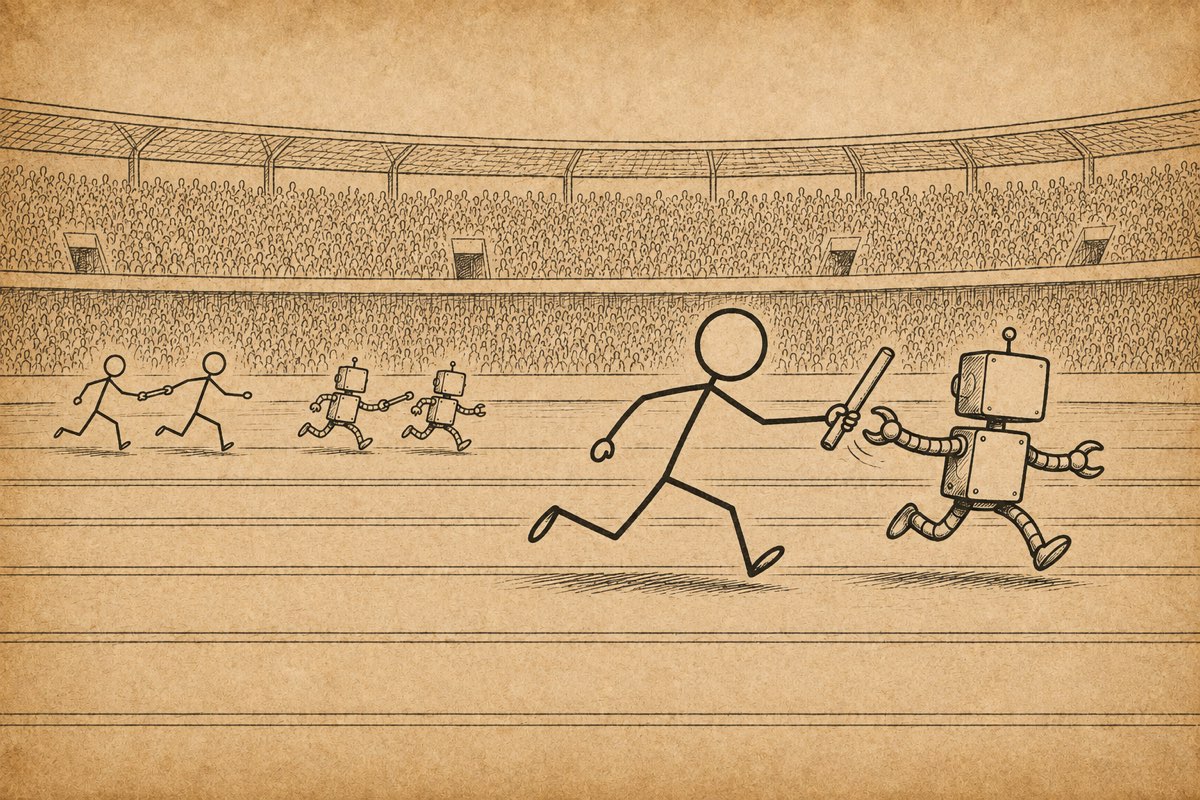
Every major transformation eventually runs into a familiar set of questions. Should this task stay within the business? Should it move to a shared service center? Can it be automated? Should it be outsourced or delivered through a managed service?
These questions have shaped service delivery models for decades. AI agents introduce another possibility that doesn’t fit neatly into any of those categories.
An AI agent is not a person, but it isn’t traditional automation either. It can be assigned an objective, interact with systems, make decisions within defined boundaries, execute a sequence of activities, collaborate with other agents and escalate when necessary. That introduces a new dimension to operating model design, with a new question:
Should this capability be delivered by people, by autonomous agents, by an external provider, or by some combination of them?
And once that question becomes part of how companies design their organizations, another follows: How do we manage all of these different resources as one combined workforce? This is an organizational question, not a technology one.
Autonomous Workforce Management (AWM)
There is a need for a new management discipline: Autonomous Workforce Management. At its simplest, AWM is the continuous allocation of work across people and autonomous systems. Its goal is to deliver the organization’s strategic objectives with the right balance of cost, quality, speed and risk.
This is broader than deploying agents. It means thinking about capacity, responsibilities, handoffs, performance, controls and accountability across a workforce that is no longer entirely human.
Consider a task common in any large organization: account reconciliations. Today, a company might have a team performing hundreds or thousands of reconciliations around month-end. Capacity is largely fixed, and the work takes time. Adding capacity means hiring people, bringing in contractors, moving work to a shared service center or outsourcing it. This is a known and defined problem that may have a new answer with an autonomous workforce.
Now imagine that the organization can deploy 500 reconciliation agents during close and scale them back when the work is finished. For anyone who has gone through a process like this in a large, complex organization, it is easy to understand the value of having that much capacity available on tap.
That doesn’t mean 500 agents independently reconciling accounts and posting whatever they determine to be correct. This workforce could include one set of agents performing reconciliations, another independently reviewing their work, and humans investigating exceptions, approving higher-risk decisions and remaining accountable for the overall process.
In other words, the unit we are designing isn’t simply an agent. It is a delivery model combining execution, review, control and human judgment. That starts looking much less like implementing a piece of software and much more like designing an organization and service delivery model.
But Isn’t This Just Better Automation?
There is an obvious counterargument. Organizations have been expanding automation for decades. Spreadsheets automated calculations. ERP systems automated bookkeeping. Workflow tools automated processes. RPA automated repetitive interactions with different systems. Agents may simply be the next step on that path: automation capable of handling complex cognitive work.
There is a lot of truth to that. Technologically, agents can absolutely be viewed as an evolution of automation. I don’t think we need to prove otherwise for the management argument to still be applicable. What changes here is the management problem.
Traditional automation largely asks: How much of this task or process can we automate?
An autonomous workforce introduces a different question: How should we allocate work across people and autonomous systems?
That means deciding not only what can be automated, but who (or what) should execute the work, who reviews it, when it should escalate, how much authority should be delegated, how capacity should scale and ultimately who remains accountable.
Those are operating model questions. And once autonomous systems begin participating in decisions and workflows alongside people, the distinction becomes increasingly important.
Traditional automation seeks to optimize tasks. Autonomous Workforce Management seeks to optimize performance, including the allocation and delivery of work.
A New Service Delivery Decision
This potentially adds another dimension to the traditional service delivery model. Historically, transformation programs have considered questions such as:
- Where should the work happen?
- Should it remain internal or be outsourced?
- Should it be centralized or distributed?
- What portions should be automated?
Autonomous capabilities add another question: What is the optimal combination of human and autonomous capacity required to deliver this capability? The answer will not always be “more agents.”
Some activities and decisions may remain predominantly human. Others may become almost entirely autonomous. Most cases will probably settle somewhere in between. And those work allocations will not necessarily remain static; they should be revised as conditions evolve.
As agent capabilities improve, economics change, and organizations gain confidence in their controls, work could continuously migrate between human and autonomous capacity. That makes workforce design less of a periodic restructuring exercise and more of a continuous optimization problem.
Managing the Hybrid Enterprise
This is where the conversation becomes much larger than IT and systems architecture. Deciding how the enterprise should allocate work isn’t fundamentally an IT decision.
IT will clearly have a critical role. Identity, access, infrastructure, security, observability and technical orchestration all matter. But the decision touches operations, finance, risk, HR and ultimately belongs to business leadership.
Someone has to decide what gets delegated, whether autonomy pays off, and how controls and escalations should work. Someone must stay accountable when it goes wrong.
The ideal interface between people and agents is still being invented (I have not seen it yet). Today, humans interact with AI through chat, while agents interact with systems through APIs, MCP servers, tools and other interfaces. Over time, those boundaries will start to blur.
The more important interface may eventually be organizational rather than technical: how work moves between humans and autonomous systems. That is the problem Autonomous Workforce Management attempts to describe.
The companies that create the most value from agents may not be those that deploy the largest number of them. They may be the companies that become the best at deciding where humans create value, where autonomous systems create value, and how to continuously redesign the organization around both.
We’ve spent decades learning how to optimize labor. The next challenge may be learning how to optimize work itself.