I learned about technology by starting with whatever machine I could get my hands on. This is true for many of my friends. Maybe it was a hand-me-down computer. Maybe it came from an office that no longer needed it. Maybe, like me, you assembled something functional from used parts that were already several generations old.
The machine did not need to be good. In some ways, it was better if it wasn’t. You could open it, change things, install things you did not understand, and occasionally break it (multiple times). If you were lucky, you figured out how to fix it. If you were less lucky, you learned why the capacitor blew (true story).
I did exactly that as a teenager with an old Apple II. The important part was not the computer. It was that once I had it, experimentation was essentially free. There was no meter running.
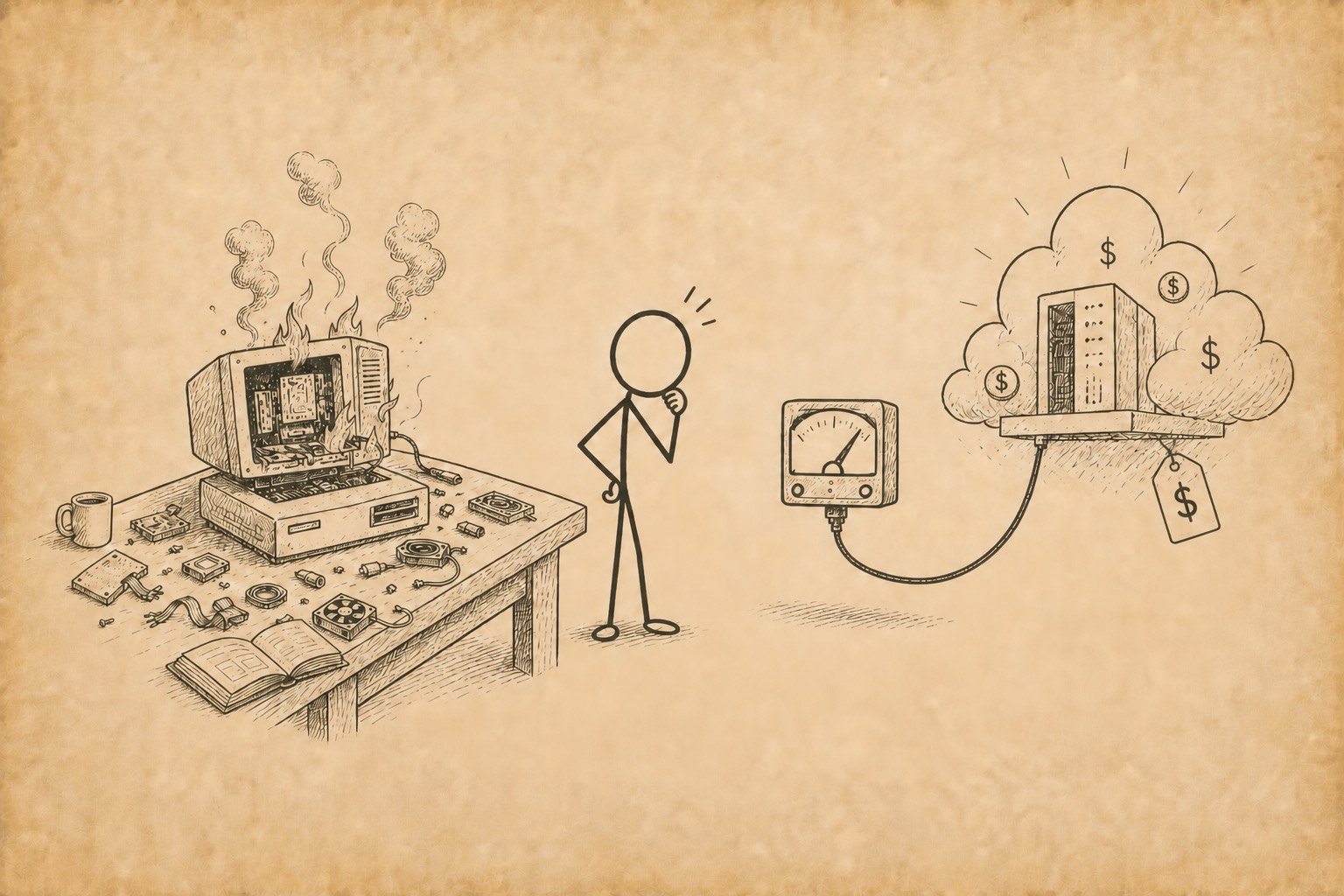
When Failure Was Cheap
The personal computer dramatically changed the economics of learning tech. Mainframes existed long before PCs, but access was scarce. People had to book time at “the machine room” when I started college. You needed to belong to an institution with a computer, get time on it, and make that time count.
The PC changed that equation because the hardware was yours. For a teenager with an old computer, or someone in a developing country piecing together a machine from used parts, there was no clear budget for experimentation. There didn’t need to be.
Note that I am not saying that experimentation was free; it was not. I remember feeling terrible for destroying network boards (and that is how I learned about impedance). But once you had the hardware, you could spend an entire weekend trying something that made absolutely no sense. You could take on a project you were not remotely qualified to complete. And that was precisely the point. You learned by figuring it out as you went. AI is changing that relationship.
Curiosity Now Has a Price in Tokens
The most capable AI systems don’t usually live on the machine in front of us. They live in somebody else’s data center. It is a miracle that we can access them through subscriptions, APIs, tokens, credits, and usage limits. For most everyday uses, this works remarkably well. The cost of an individual request can be very small.
But tinkering is not about individual requests. Tinkering is inefficient by definition.
It means trying the wrong thing. Asking bad questions. Starting over. Running something 50 times because you don’t understand why it failed (or why it worked when it shouldn’t have). Following an idea for three hours before discovering that it goes nowhere.
Put a meter on that process and something changes. You begin to think about whether an experiment is worth running before you run it. That is rational. Economically, it makes sense. But many of the people who learned computing by taking apart old machines weren’t being particularly rational. They were just curious.
Curiosity and eureka moments benefit enormously from cheap failure.
Owning the Hardware Matters
There is also a meaningful distinction between inexpensive access to something and owning it. Free credits aren’t ownership. Neither is a generous subscription.
When the machine is yours, you can use all of it. You can leave it running overnight. You can misuse it. You can attempt something absurd. You can break it. You can connect it to another piece of hardware you own and create a new thing.
The consequence of failure belongs to you, and so does the freedom to fail.
Running capable AI locally can recreate some of that freedom, but today the hardware required to run the truly capable models is well beyond the kind of discarded computer a curious teenager might procure with minimal resources. That creates a strange situation.
Computing spent decades moving from centralized machines toward increasingly powerful computers that individuals could own. AI is moving a part of the fundamental computing stack back toward centralized infrastructure.
The mainframe was shared because computing was too expensive to own. We are returning to that economic scenario.
The Projects We Never Start
The biggest consequence may not be the money spent on tokens. It may be the projects that never happen.
There is a particular mindset that comes from having a machine you can break: “I don’t know how to do this, but I’ll figure it out.” That is different from asking whether the tools available to any one of us are capable of doing it or not.
The PC revolution and the Internet gave millions of people machines they could experiment with badly, inefficiently, and endlessly. A good amount of knowledge came from people attempting things they had no business attempting with equipment nobody particularly cared if they broke.
AI gives us capabilities those early computer users could barely have imagined. However, capability and freedom to experiment are not the same thing. In the past we learned on machines we could break; today we learn on systems that charge us not to.
What kind of builders will a “token-metered world” produce?